Melmoth and Othello
Three Bags FullMelmoth and Othello share a mentor–apprentice bond shaped as much by abandonment as by instruction. Melmoth taught Othello how to endure fear and fight, and his remembered voice had helped save Othello’s life; yet he also left Othello behind with the cruel clown. When they meet again, Othello must reckon with the possibility that the teacher who formed him may not have cared for him as deeply as he cared for the teacher. Their reunion turns that private hurt into a question of whether Melmoth can again lead others, this time an entire flock.
Instruction and Survival
Othello’s connection to Melmoth reaches back to a rainy night at the circus. Melmoth galloped past the tents while Othello watched from behind bars and the cruel clown lay in the mud shouting for a light. Othello never forgot the encounter: for years, he knew he had to find Melmoth again. The memory establishes Melmoth as a figure of freedom and force before he becomes a teacher, while the bars place Othello on the other side of that freedom.
Melmoth’s instruction encompassed patience, attention, and action. He taught Othello about fire and water, about watching a snail’s slimy trail, and about sending rage and fear back to the world they came from. He also showed him how to watch his own thoughts and how to fight. These lessons are practical, but they ask for more than technique: they train Othello to observe what arises within him rather than be ruled by it. Melmoth’s voice continued to accompany Othello after their separation, and Othello credits it with saving his life more than once.
One lesson proved harder to accept than the rest: Melmoth’s view that being alone could be an advantage. Othello repeated the principle angrily because his own experience had contradicted it. Alone with four dogs, two ferrets, and a white goose, he had not felt strengthened by solitude; he had felt hurt. The gap between Melmoth’s teaching and Othello’s lived experience becomes the central wound in their relationship.
Separation and Resentment
Melmoth had left Othello behind with the cruel clown. Othello, for his part, had slipped away by night from the clown’s animal trailer without a proper goodbye, offering only the same remark about the advantage of being alone. The history is therefore not a simple story of one-sided rejection: Melmoth’s departure wounded Othello, while Othello’s own exit left an unfinished parting between them. The remembered lesson, used as his parting words, carries both Melmoth’s influence and Othello’s anger at it.
When Melmoth later appears among Othello’s new flock, Othello hides from him, unable to decide how to respond. He knows Melmoth has recognized him, yet the older ram leaves him alone. Othello fears that this silence means he is merely one sheep among countless others encountered during Melmoth’s lonely wanderings, a member of a faceless flock in which the teacher takes no particular interest. The possibility feels worse to Othello than any direct rebuke: the person whose attention shaped his life may have regarded him as incidental.
The Reunion and the Old Ram
Othello eventually trots toward Melmoth with his heart pounding and his stomach queasy. He is relieved to have a reason to face him, but embarrassed to meet the ram who knows him so well. Melmoth had seen the mistakes of Othello’s youth and criticized them mercilessly. Othello’s embarrassment irritates him, partly because he recognizes the awkwardness of their unfinished history and cannot make it disappear simply by being angry.
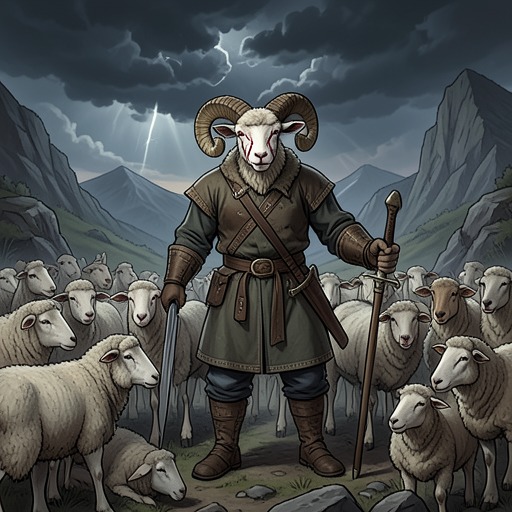
Facing Melmoth also changes Othello’s view of his teacher. The ram who once seemed to move with effortless, controlled power has grown old; his long beard makes visible a weight Othello had never imagined him carrying. Othello wonders whether he could still fight Melmoth and is horrified to find that the possibility has entered his mind. As a young sheep, he had protested that he did not know how to fight. Melmoth had answered that fighting depended not on knowing how but on wanting to do it. Remembering the exchange, Othello feels admiration for the will and wisdom that carried Melmoth through a life of loneliness. The apprentice’s anger remains, but it no longer prevents him from seeing the teacher’s vulnerability.
A Wider Test of the Bond
Their reunion does not begin with a full explanation or a settled reconciliation. Melmoth turns a play duel with Sir Ritchfield into a game, allowing the other ram to defeat him and rolling in the grass like a puppy. Then he invites Othello into a new game about the big black sheep and asks what that sheep is afraid of. The shift from mischievous play to a serious gaze makes the encounter feel like a test, but its immediate effect is to unsettle Othello rather than resolve their past.
Othello’s first concrete act of renewed trust is to tell Melmoth what Zora discovered about Gabriel. He proposes that the flock escape and asks Melmoth to lead them. The request enlarges their old relationship: Melmoth’s knowledge and authority, once directed toward a young sheep’s survival, may now be needed by many sheep. Melmoth registers the scale of the request by looking across the expectant flock and asking whether Othello means all of them. He returns to the principle that solitude can be an advantage, the very lesson Othello had never believed. The available scene leaves the question of leadership open, but makes clear what is at stake: whether a teaching formed in isolation can serve a flock, and whether Othello can ask his former mentor for help without pretending that the hurt between them never happened.